
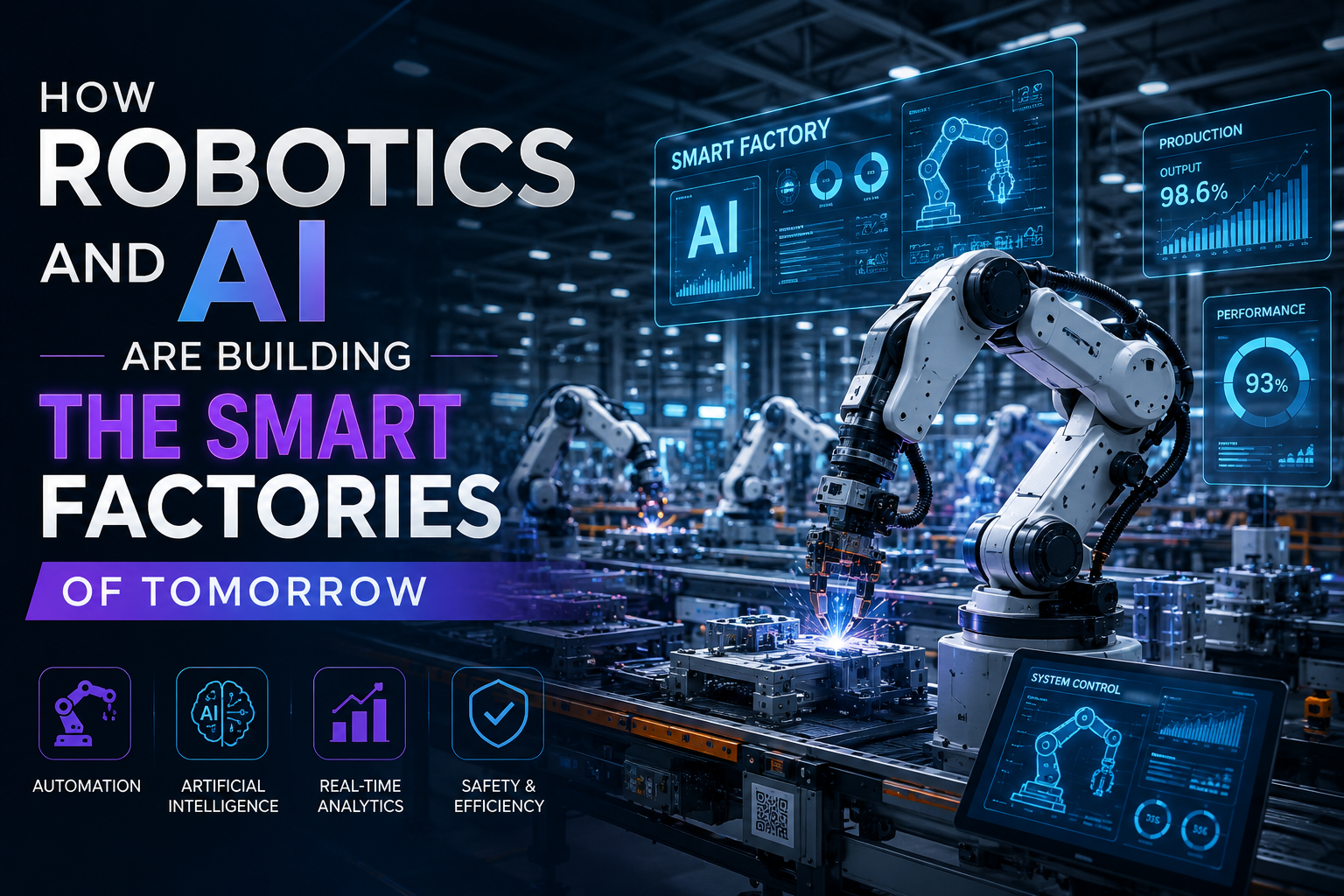
The manufacturing industry is entering a new era of innovation. Around the world, companies are replacing traditional production methods with intelligent technologies that improve speed, quality, and efficiency. At the center of this transformation are Artificial Intelligence (AI) and robotics, two powerful technologies that are changing how factories operate. Smart factories are no longer just a concept. They are becoming the foundation of modern manufacturing, helping businesses produce better products while reducing costs and improving workplace safety
What Is a Smart Factory?
A smart factory is a manufacturing facility that uses connected technologies such as Artificial Intelligence, robotics, sensors, cloud computing, and the Internet of Things (IoT) to automate and optimize production.
Unlike traditional factories, smart factories continuously collect and analyze data from machines and equipment. This allows production systems to identify problems, improve efficiency, and make decisions in real time with minimal human intervention.
The goal is simple: produce high-quality products faster, with fewer errors and less waste.
The Growing Role of Robotics
Industrial robots have become an essential part of modern factories. These machines are designed to perform repetitive, precise, and physically demanding tasks that would otherwise require significant human effort.
Today, robots are commonly used for:
- Product assembly
- Welding and metal fabrication
- Painting and coating
- Packaging and labeling
- Material handling
- Quality inspection
Modern robotic systems work with incredible accuracy and can operate around the clock. This increases production capacity while reducing mistakes and manufacturing costs.
Collaborative robots, also known as cobots, are becoming increasingly popular. Unlike traditional industrial robots, cobots are designed to work safely alongside human employees, assisting them with repetitive tasks while allowing workers to focus on more skilled responsibilities.
How Artificial Intelligence Makes Factories Smarter
While robots perform physical work, Artificial Intelligence acts as the decision-making system behind the factory.
AI processes large volumes of production data to identify patterns, predict future events, and recommend improvements. Instead of waiting for equipment to fail, AI can detect early warning signs and schedule maintenance before a breakdown occurs.
Some of the most common applications of AI in manufacturing include:
Predictive Maintenance
AI continuously monitors machine performance and predicts when equipment needs servicing. This reduces unexpected downtime and extends the life of expensive machinery.
Quality Control
AI-powered computer vision systems inspect products at high speed, identifying defects that may be difficult for the human eye to detect. This improves product quality and reduces waste.
Production Planning
AI analyzes customer demand, inventory levels, and production capacity to create optimized manufacturing schedules. This helps companies meet delivery deadlines more efficiently.
Inventory Management
Smart AI systems monitor stock levels automatically and forecast future demand, helping businesses avoid shortages and reduce excess inventory.
Energy Optimization
Factories consume large amounts of electricity. AI helps reduce energy consumption by optimizing machine usage and identifying opportunities to improve efficiency.
Benefits of Smart Factories
The combination of AI and robotics provides significant advantages for manufacturers.
Increased Productivity
Automation enables factories to produce more products in less time without sacrificing quality.
Improved Product Quality
AI-powered inspection systems detect defects earlier in the production process, ensuring consistent quality.
Lower Operating Costs
Automation reduces manual labor for repetitive tasks, minimizes material waste, and lowers maintenance expenses.
Enhanced Workplace Safety
Robots can safely perform dangerous tasks such as heavy lifting, welding, and working in hazardous environments, reducing the risk of workplace injuries.
Faster Decision-Making
Real-time production data allows managers to make informed decisions quickly, improving overall factory performance.
Sustainable Manufacturing
Smart factories optimize energy use, reduce waste, and improve resource management, supporting environmentally friendly manufacturing practices.
Challenges of Smart Manufacturing
Although smart factories offer many benefits, businesses also face several challenges during implementation.
The initial investment in robotics, AI systems, and digital infrastructure can be significant. Companies also need skilled professionals who understand automation, data analysis, and machine learning.
Cybersecurity is another major concern. As factories become more connected, protecting production systems from cyberattacks becomes increasingly important.
In addition, businesses must provide training to employees so they can work effectively alongside intelligent machines.
The Future of Manufacturing
The future of manufacturing will be driven by intelligent automation and connected technologies.
Advances in AI, robotics, 5G connectivity, cloud computing, and digital twins will make factories even more efficient and flexible. Machines will communicate with one another, predict production needs, and solve operational problems with minimal human involvement.
Human workers will continue to play a vital role by managing operations, solving complex challenges, developing new products, and making strategic business decisions. Rather than replacing people, AI and robotics will enhance human capabilities and create new career opportunities in advanced manufacturing.
Conclusion
Artificial Intelligence and robotics are transforming manufacturing into a smarter, faster, and more efficient industry. Smart factories use intelligent machines, real-time data, and advanced automation to improve productivity, reduce costs, and deliver higher-quality products.
As technology continues to evolve, businesses that invest in AI-powered manufacturing today will be better prepared for tomorrow’s competitive market. The factory of the future is not simply automated—it is intelligent, connected, and built to adapt to the changing demands of the modern world.